
Sugar feeds cancer cells: fact or myth?

The belief that sugar feeds cancer cells is widespread, appearing frequently in books, blog posts and social media. It often leads to confusion not only among patients but even among healthcare professionals. For dietitians, providing clear, evidence-based information is essential to support accurate and informed dietary advice. This requires exploration of the relationship between sugar and cancer, examination of the origin of the claim, the scientific evidence and understanding how dietitians can respond in clinical practice.
The origin of the claim
Some patients worry that sugar causes cancer to grow and spread more quickly. But where does this idea come from?
Cancer is a disease of cells. Like all cells in the body, cancer cells require energy to grow and function. Glucose is the body’s primary energy source. Cancer cells usually grow and divide rapidly, which increases their energy demands. As a result, they tend to take up glucose at a higher rate than normal cells, a metabolic phenomenon known as the Warburg effect, where they favour a fast but less efficient way of producing energy.[1] This increased glucose uptake is also why techniques such as positron emission tomography (PET) scans use a radioactive glucose analogue tracer to detect cancer cells throughout the body.[2]
Moreover, high sugar intake is associated with insulin resistance and chronic inflammation.[3] These metabolic changes may influence cancer‑related pathways, including inflammatory signalling and increased insulin‑like growth factors, which are involved in tumour development and progression.
Does sugar feed cancer cells?
While these mechanisms provide a biological basis for concern, they are often oversimplified in public messaging, leading to the misleading conclusion that sugar directly feeds cancer. This has encouraged the belief that dietary restriction alone can improve prognosis or reduce recurrence risk.
Sugar exists in many different forms. Simple sugars are single molecules such as glucose and fructose, which can combine to form sucrose (table sugar) or longer chains known as complex carbohydrates. These are found in foods such as grains, pulses, fruits and vegetables.
Glucose is essential fuel for the body. Cutting sugar from the diet does not selectively deprive cancer cells of glucose as all healthy cells rely on it too. The body cannot distinguish between cancer cells and healthy cells when supplying fuel. In addition, cancer cells are metabolically flexible and can use other fuel sources including amino acids and fats, when glucose availability is reduced.[4]
For this reason, avoiding sugar will not starve cancer cells or directly stop tumour growth. Instead, excessive dietary restriction may increase the risk of inadequate energy intake and malnutrition, particularly during cancer treatment.
Sugars are also present in many foods associated with health benefits including complex carbohydrates, fruits and vegetables. These are high in fibre, vitamins, minerals and bioactive compounds and have been linked to a lower risk of cancer.[5]
Overall, there is no evidence that consuming sugar directly accelerates cancer progression. Blood glucose levels are tightly regulated through processes such as glycogenolysis and gluconeogenesis, regardless of dietary sugar intake. As a result, attempting to starve cancer through sugar restriction is neither effective or safe.
Why are we encouraged to limit sugar?
If cutting out sugar does not prevent or treat cancer, why do public health messages encourage reducing sugar intake?
The reason is the indirect link between cancer risk and sugar. Diets high in sugary foods and drinks can contribute to weight gain over time, and living with overweight or obesity is associated with an increased risk of at least 13 types of cancer. After smoking, overweight and obesity represent one of the most significant modifiable risk factors for cancer.[6] Excess fat tissue is associated with elevated insulin resistance and chronic inflammation, both of which are linked to cancer development.
Foods and drinks high in free sugars tend to provide little nutritional value and can displace more nutrient‑dense options. Public health guidance recommends focusing on reducing excess free sugars rather than avoiding all sugars or carbohydrates. In practice, this means limiting sugary drinks, cakes, biscuits, sweets and sweetened spreads. The goal is not to eliminate sugar but to support a balanced, nutrient‑dense diet that helps maintain a healthy weight and overall health.
Myths and reality
The idea that sugar feeds cancer cells is a myth. The reality is that:
Cutting out sugar in the diet does not restrict glucose to cancer cells.
Sugars are found in healthy foods which are high in vitamins, minerals and fibre and have been linked with a lower cancer risk.
It is, however, recommended to reduce excessive sugar in the diet, especially free sugars or simple sugars as these are linked with being overweight.[7]
How should dietitians respond?
Patients frequently ask if it is necessary to restrict or eliminate sugar from their diet to improve prognosis or reduce the risk of recurrence, concerns that are shaped by strong media narratives and misinformation. A supportive, respectful and evidence‑based approach is essential.
When counselling such patients, it is important to explore their understanding and beliefs about diet and its influence on cancer. If a patient is interested in, or already following, a cancer‑specific diet, their expectations and experiences should be discussed openly. This is not about challenging beliefs all at once, but about gently encouraging curiosity and reassurance. Most importantly, it is about maintaining an open, trusting conversation so patients continue to engage with dietetic support.
Where appropriate, patients can be signposted to reliable, evidence‑based resources such as the BDA Cancer Diets: Myths and More resource and Cancer Research UK.
When talking to patients, suggested phrasing includes:
“I can see how much thought and effort you’ve put into this. It sounds like you’re being proactive in taking care of yourself.”
“That’s interesting. Where did you hear that?”
“Tell me more about what made you decide to try that.”
“I completely understand there’s so much information out there and it’s not always easy to know what’s reliable.”
“Would it be okay if we explored this together – what the evidence shows and how this might interact with your treatment?”
“My role isn’t to take control away from you – it’s to support you in making decisions that protect your health and your hopes.”
Conclusion
While cancer cells do use glucose as a source of energy, this does not mean that dietary sugar directly fuels cancer growth in a way that can be controlled through restriction. The evidence does not support eliminating sugar as a strategy to treat or prevent cancer, and doing so may risk compromising overall nutritional status. Instead, the focus should remain on a balanced, nutrient-dense diet that supports health, maintains a healthy weight and meets individual needs. Dietitians play a key role in addressing misconceptions, guiding patients through complex and often conflicting information and supporting informed, sustainable dietary choices.
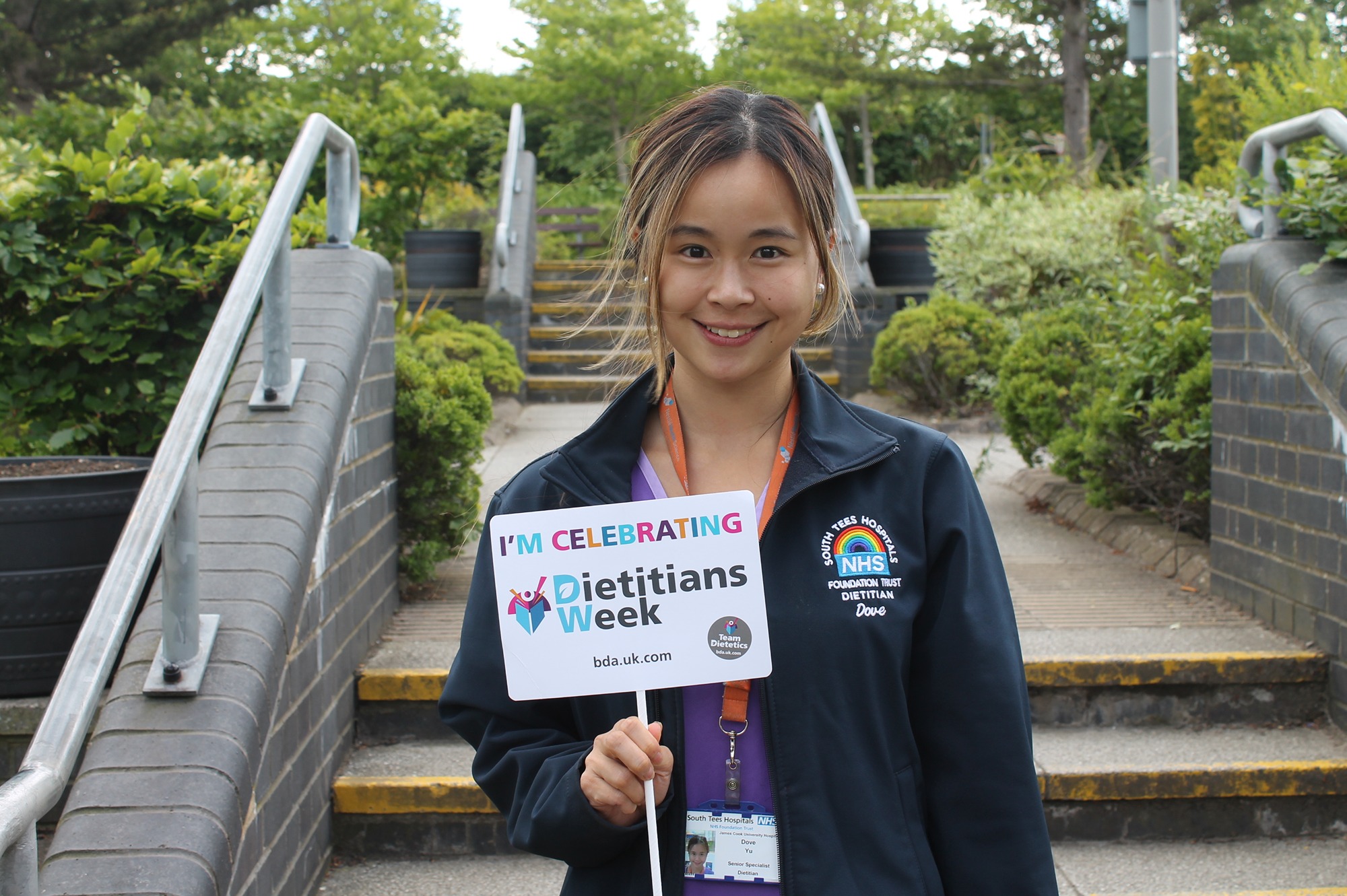
Dove is a Senior Specialist Dietitian (Oncology – Upper GI) at South Tees Hospitals NHS Foundation Trust. She supports patients across hospital and community settings, specialising in evidence-based, person-centred oncology nutrition. She is also a committee member of the BDA Oncology Specialist Group and the BDA Older People Specialist Group.
Dove Yu RD ANutr
References:
Liberti MV, Locasale JW. The Warburg effect: how does it benefit cancer cells? Trends Biochem Sci. 2016.41(3):211‑218. doi:10.1016/j.tibs.2015.12.001
Kapoor M, Heston TF, Kasi A. PET scanning. In: StatPearls [Internet]. Treasure Island (FL): StatPearls Publishing; updated February 26, 2025. Accessed April 10, 2026 https://www.ncbi.nlm.nih.gov/books/NBK559089/
Hasan N, Yazdanpanah O, Khaleghi B, Benjamin DJ, Kalebasty AR. The role of dietary sugars in cancer risk: a comprehensive review of current evidence. Cancer Treat Res Commun. 2025.43:100876 doi:10.1016/j.ctarc.2025.100876
Cancer Research UK. Sugar and cancer: what you need to know. Published August 16, 2023 Accessed April 10, 2026 https://news.cancerresearchuk.org/2023/08/16/sugar-and-cancer-what-you-need-to-know/
Ubago‑Guisado E, Rodríguez‑Barranco M, et al. Evidence update on the relationship between diet and the most common cancers from the European Prospective Investigation into Cancer and Nutrition (EPIC) study: a systematic review. Nutrients. 2021;13(10):3582. doi:10.3390/nu13103582
World Cancer Research Fund International. Weight and cancer. Accessed April 10, 2026 https://www.wcrf.org/preventing-cancer/topics/weight-and-cancer/
British Dietetic Association. Cancer diets: Myths and More. Accessed April 10, 2026 https://www.bda.uk.com/resource/cancer-diets-myths-and-more.html
Comments