
The role of meat and dairy foods in healthy ageing

The UK population is ageing. By 2040, almost one in seven people is expected to be aged over 75.[1] In 2025, an estimated 22.3 million people in England were aged over 50. By 2045, this is projected to rise to 26.6 million (42% of the population).[2] Diet and lifestyle play a key role in optimising health as we age.
Consumption of meat and dairy in older adults
In the UK, 77% of adults aged 65+ years report that they eat meat.[3] Among older adults (65+ years), the average intake of red and processed meat is 51g a day (men: 63g, women: 41g), which is well below the recommended limit of 70g per day.[4] However, the proportion of unprocessed and processed meat is similar among adults, indicating the need to reinforce the advice to limit processed meat intake.[5]
Dairy is consumed by 99% of adults, with those aged 75 and over being among the highest consumers of milk.[6] Average total dairy intake among adults aged 75+ was 283g a day, with the majority coming from milk (224g), yoghurt (29g) and cheese (17g), with small proportions coming from butter (8.7%) and cream (4.5%).[6]
The importance of protein for healthy ageing
Protein is particularly important as we age as it helps us maintain muscle mass, strength and overall health.
Compared to younger adults, older adults often eat less overall, including less protein. One study looking at protein intakes of older adults in the UK found that fewer than 50% met current protein recommendations, suggesting that protein intake may be suboptimal in this age group.[7]
Protein quality is also important, including amino acid contribution, digestibility and absorption. Branch-chain amino acids (BCAA), particularly leucine, play a key role in stimulating muscle protein synthesis. Meat and dairy are high-quality protein sources, rich in BCAAs. Evidence from a systematic review suggests that adequate dietary leucine may be especially beneficial for stimulating muscle protein synthesis in older adults.[8]
Key micronutrients for older adults
Recent National Diet and Nutrition Survey data for adults aged 65–74 years and 75+ years shows:[9]
Meat and meat products were major contributors to zinc (26%, 25%), selenium (25%, 24%), vitamin B12 (24%, 24%) and vitamin D (23%, 22%).
Milk and milk products were major contributors to calcium (42%, 45%), iodine (42%, 44%), vitamin B12 (30%, 32%) and vitamin B2 (32%, 34%).
See Table 1 for further information.
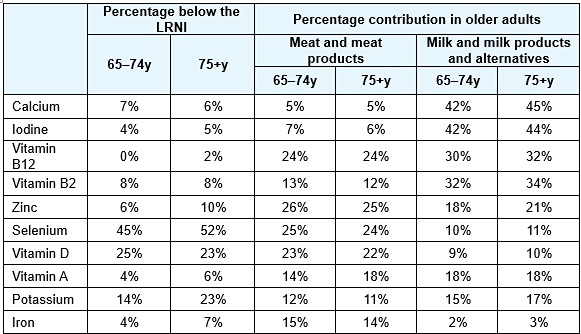
Table 1:
Percentage of older adults with intakes of key micronutrients below the Lower Reference Nutrient Intake (LRNI) and the contribution of meat and dairy.[9] Note that the LRNI is the amount of a nutrient that is enough for only a small number of people in a group who have low requirements (2.5%) ie the majority need more. [9]
Maintaining muscle mass
Age-related muscle loss starts in midlife at around 1% per year and may reach up to 50% by the time a person is in their eighties or nineties.[10] Consuming high-quality protein foods, like meat and dairy, in at least two meals a day helps maximise muscle protein synthesis and thus reduce the likelihood or progression of sarcopenia (muscle wasting) and frailty.[11] As muscles become less efficient at using dietary protein with age, higher intakes are needed to achieve the same benefit. High-quality protein sources, particularly meat and dairy, are therefore important for optimising protein synthesis in older adults.[12]
Supporting bone health
Dairy is a key source of calcium and many other bone-supporting nutrients such as protein, phosphorus, potassium, magnesium, vitamin K2 and zinc.
Nutrition is likely to have an important impact on bone health during key life stages such as the menopause transition and older age, which are more prone to bone mineral loss. Evidence from randomised controlled trials have shown dairy intake improves bone mineral density. One trial of 7195 older adults reported a 33% reduction in all fractures within three to five months of adding one extra serving of dairy a day.[13]
Reducing the risk of undernutrition
Around one in 10 people aged over 65 in the UK are malnourished or at risk of malnutrition.[14] Red meat and dairy foods contain a lot of nutrients in a small serving, meaning moderate portions are highly effective in meeting nutritional needs. Such nutrient-dense foods can be particularly useful among older adults who often eat less food.
Supporting the gut microbiome
Fermented dairy foods such as yoghurt and kefir are key dietary sources of probiotics, providing beneficial bacteria that support gut health and microbial diversity. This may be especially beneficial in older adults as digestion slows and microbial diversity tends to decline with age.
Conclusion
Nutrient-dense foods such as meat and dairy can help maintain muscle mass, support bone health and provide important micronutrients that are often low in older adults, including B-vitamins, calcium, iron, zinc and selenium.
The high-quality protein and bioavailable micronutrients provided by meat and dairy can help ensure older adults optimise their nutrient intake, especially as overall food intake and appetite tend to decrease in older age.

Laura is an Independent Nutrition Consultant with interests in menopause, healthy ageing and public health. She specialises in reviewing scientific evidence and translating the findings into clear messages.
Dr Laura Wyness RNutr
References
Government Office for Science (2016) Future of an Ageing Population. London: Government Office for Science. Available at: https://www.gov.uk/government/publications/future-of-an-ageing-population
Reeves C, Islam A, Gentry T (2025) The State of Health and Care of Older People in England 2025. London: Age UK. Available at: https://www.ageuk.org.uk/siteassets/documents/reports-and-publications/reports-and-briefings/health--wellbeing/state-of-health-and-care/state-of-health-care-of-older-people-in-england-2025.pdf
YouGov (2026) Percentage of meat eaters – YouGov [dataset]. YouGov, Dietary choices of Brits. Available at: https://yougov.com/en-gb/trackers/dietery-choices-of-brits-eg-vegeterian-flexitarian-meat-eater-etc
SACN (Scientific Advisory Committee on Nutrition) (2010) Iron and health. London: TSO. Available at: https://www.gov.uk/government/publications/sacn-iron-and-health-report
World Cancer Research Fund American Institute for Cancer Research (WCRF/AICR). Continuous Update Project (CUP) Expert Report (WCRF/ AICR) (2018) Meat, fish and dairy products and the risk of cancer. Available at: https://www.wcrf.org/wp-content/uploads/2024/10/Meat-fish-and-dairy-products.pdf
Food Standards Scotland (FSS) (2024) Modelling the impact of reductions in meat and dairy consumption on nutrient intakes and disease risk. Available at: https://www.foodstandards.gov.scot/downloads/Summary_briefing_-_Modelling_the_impact_of_reductions_in_meat_and_dairy_.pdf
Morris S, Cater JD, Green MA, et al. Inadequacy of protein intake in older UK adults. Geriatrics. 2020;5(1):6. doi: https://doi.org/10.3390/geriatrics5010006
Zaromskyte G, Prokopidis K, Ioannidis T, et al. Evaluating the leucine trigger hypothesis to explain the post-prandial regulation of muscle protein synthesis in young and older adults: a systematic review. Frontiers in Nutrition. 2021.8(685165). doi: https://doi.org/10.3389/fnut.2021.685165
OHID (Office for Health Improvement & Disparities) (2025) National Diet and Nutrition Survey 2019 to 2023. Office for Health Improvement & Disparities: London. Available at: https://www.gov.uk/government/statistics/national-diet-and-nutrition-survey-2019-to-2023/national-diet-and-nutrition-survey-2019-to-2023-report
Wilkinson DJ, Piasecki M, Atheron PJ. The age-related loss of skeletal muscle mass and function: Measurement and physiology of muscle fibre atrophy and muscle fibre loss in humans. Ageing Research Reviews. 2018.47:123-32. doi: https://doi.org/10.1016/j.arr.2018.07.005
Lyons OC, Flynn MAT, Corish CA, et al. Nutrition policy: developing scientific recommendations for food-based dietary guidelines for older adults living independently in Ireland. Proc Nut Soc 2022.81:49-61. doi: https://doi.org/10.1017/S0029665122001008
Berrazaga I, Micard V, Gueugneau M, Walrand S. The role of the anabolic properties of plant-versus animal-based protein sources in supporting muscle mass maintenance: a critical review. Nutrients 2019.11(8):1825. doi: https://doi.org/10.3390/nu11081825
Iuliano S, Poon S, Robbins J, et al. Effect of dietary sources of calcium and protein on hip fractures and falls in older adults in residential care: cluster randomised controlled trial. The BMJ. 2021.375: n2364. doi: https://doi.org/10.1136/bmj.n2364
The Malnutrition Task Force (2024) State of the Nation 2025: Older people and malnutrition in the UK today. London: The Malnutrition Task Force. Available at: https://www.malnutritiontaskforce.org.uk/sites/default/files/2025-08/State%20of%20the%20Nation%202025%20revised.pdf
Comments