
The role of fibre beyond digestion
What is fibre?
Fibre is the part of plant foods that is resistant to digestion; it passes into the colon where it is fermented by the gut bacteria. Fibre is not just one entity but is made up of non-starch polysaccharides from plant cell walls as well as resistant starch and fructans.[1]
There are various forms of fibre, and while it’s commonly consumed as a laxative through pills and powders to help with constipation, it’s also used in food processing as thickeners and gels. The main characteristics that have an impact on its functions include how well it dissolves in water, how well it’s broken down by our gut and how thick it is.[2]
One common type is soluble fibre. This dissolves in water and forms a gel, which slows down the gut transit, keeping you fuller for longer and helping soften the stool. Types of soluble fibre include fruits, vegetables, oats, gums and extracts.
Insoluble fibre adds bulk to your stool and does not dissolve in water, helping to speed up the stool along the gut. Types include cereal grains, beans, vegetables and seeds.[3]
Resistant starch is a type of soluble fibre and acts as a prebiotic, having positive effects on human health. When foods such as cooked potatoes, pasta and rice are cooled, it increases the resistant starch.[4]
Fibre recommendations
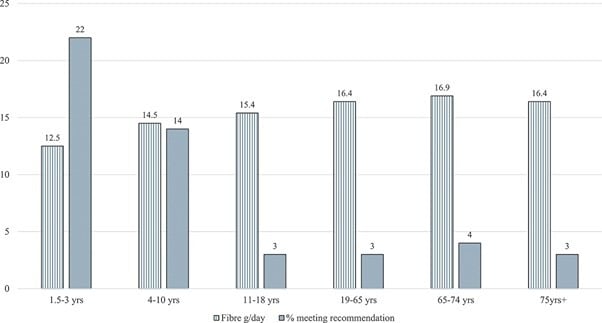
Figure 1 UK fibre intakes (g/day) and percentage meeting guidelines across the life course. Key: Fibre recommendation cut-offs: 2–4 year children ≥15.0 g/day, 5–10 year children ≥20.0 g/day, 11–15 year old children ≥25.0 g/day, 16–18 year old children ≥30.0 g/day, 19 year old and over adults ≥30.0 g/day. Source: Data extracted from UK NDNS (OHID, 2025a).
The government recommends adults should consume 30g of dietary fibre daily, and WHO recommends everyone above 10 years of age should aim for at least 400 grams of fruits and vegetables per day, with reduced amounts for children under 10: at least 250 or 350 grams for children two–five or six–nine years of age.[5]
The National Diet and Nutrition Survey 2019-2023 showed that children and adults did not meet their fruit and vegetables recommendations of five portions per day, and 96% of children and adults did not meet the fibre recommendations.[6]
How does fibre support our health
Fibre-containing foods such as fruits, vegetables, legumes, wholegrains, nuts and seeds not only contribute to the range of nutrients and phytochemicals. Research indicates that those who have more plant-based, fibre-rich diets have better health outcomes in the protection of chronic disease.[7]
Fibre helps lower bad cholesterol; some dietary fibres can reduce inflammation and a diet rich in fibre may support weight management, which is important for heart health. Research shows that higher fibre intake is correlated with reduced cardiovascular risk and mortality, but what’s important is the quality and quantity of fibre consumed.[8]
Dietary fibre also supports our gut microbiome, and short-chain fatty acids are the by-products of fibre when fermented in the gut. It’s these short-chain fatty acids that can help lower blood sugar response and may help with weight management. Short-chain fatty acids can play a role via the gut-brain axis and have direct effects on hypothalamic regulation of metabolic pathways, immunity and appetite.[9]
As well as preventing constipation and supporting digestion, eating more fibre helps diversify our gut microbiome, supports better blood sugar control, provides more satiation and lowers blood pressure and LDL cholesterol. It also has a protective effect on the risk of developing cardiovascular disease, type 2 diabetes, stroke and colorectal cancer.[10]
How to increase fibre intake
Gradually increasing fibre is the most sensible way to reduce the risk of bloating and gas. Patients with digestive issues should see a dietitian if concerned about increasing fibre and always consult a GP if experiencing any gut-related problems.
Consuming 30 different plant-based foods a week and following a Mediterranean-type diet can be a good way to optimise your fibre intake.
Add a tablespoon of flaxseeds or chia seeds into yoghurt and porridge.
Wholemeal/ seeded/ rye bread and potatoes and fruit and vegetables with the skin on provide more fibre.
At every meal, aim for a portion of vegetables and vary the type of complex carbohydrates.
Add pulses; an 80g portion of pulses counts towards one of the five-a-day.
If you have white pasta/white rice, switch to brown rice/wholewheat pasta.
Snack on vegetables and nuts and seeds to optimise fibre intake.
Breakfast can be a good way to get more fibre; porridge is made from beta-glucan-containing oats, which can help lower LDL cholesterol, supporting heart health.
Incorporate various grains: quinoa, bulghur wheat, barley, brown rice, freekeh, whole wheat couscous.
Read food labels – high-fibre foods will contain 6g of fibre or more per 100g
Conclusion
Fibre is a crucial type of carbohydrate in our diet and has many health advantages. As a nation, we’re lacking fibre and increasing the types and quantity of fibre gradually can be beneficial. Starchy foods are an important source of energy and we should opt for the high-fibre versions.
The Scientific Advisory Committee on Nutrition has found that most of the evidence for the array of health benefits of fibre comes from studies which show that dietary fibre intake, achieved through a variety of foods and some isolated fibres, has positive effects on blood lipids and colorectal function. We should obtain our fibre, including soluble and insoluble, from a variety of foods to support our overall health. [11]

Gopi works as a nutritionist in the NHS specialising in weight management as well as freelancing. She also does 1-1s, supports public health campaigns, media and recipe development as well as works with charities like world cancer research fund providing evidence-based nutrition. Her interests include cancer, intuitive eating and gut health.
Gopi Chandratheva RNutr
References:
Comments