
Water – simple yet essential
Water is so embedded in daily life that its importance is often overlooked until supply, quality or access is called into question. National media coverage of the recent water supply issues in the South East of England got me thinking in more depth about this vital liquid.[1]
In the UK, the water industry treats around 16 billion litres of water per day, supplying it directly to the majority of households around the country.[2] Drinking water in the UK is sourced from a range of locations, which include reservoirs, rivers, groundwater aquifers and in some places, the sea. The water is subject to some of the strictest treatment processes in the world.[2] Overseen by the independent Drinking Water Inspectorate (DWI), the water industry processes our water to ensure it is safe, clean and available to UK households.[2]
The water market
Water is the most consumed drink across the globe. It also has an increasing share of the packaged beverages market; in 2023, around 35% of all packaged beverages were water.[3] In 2024, the UK bottled water market was worth around £2.3 billion, equating to the consumption of approximately 3.1 billion litres of bottled water.[4] The market has seen growth of £1.3 billion between 2013 and 2024.[4]
Aside from our tap water supply and the packaged water market, there is a whole range of water-related paraphernalia available out there... home water filter systems, taps and jugs, water coolers and dispensers and water softeners, to name a few.
Some people take water very seriously – so seriously, in fact, that water-tasting experiences now exist. Just as wine or other beverages made from natural ingredients can vary depending on their origin and processing, water from different sources has its own characteristics and nuances. Not all waters are created equally!
Biological importance
Water is a vital part of life on Earth. We need water to survive and thrive, with it playing several roles in our biological functions.
Water makes up about 55–75% of the human body and is essential for cellular processes, digestion, circulation and temperature regulation.[5,6] Supporting life at cellular and systemic levels, it provides a medium for biochemical reactions, including metabolism and enzyme activity.
Metabolic medium – Most biochemical reactions occur in aqueous environments. Enzymatic processes, protein folding and cellular respiration depend on water as a medium.
Transport of substances – Blood and cellular fluids rely on water to carry nutrients, hormones, oxygen and waste products throughout the body.
Temperature regulation – Water has a high heat capacity, which allows us to maintain stable internal temperatures. Processes such as sweating or transpiration rely on evaporative cooling.
Water is also critical for photosynthesis, enabling plants to produce oxygen and glucose, both of which are essential for human survival.
Benefits of consuming water
Aside from its biological functions, drinking water is good for our health in many other ways:[5,7]
Prevents dehydration, which can cause mood and memory problems, constipation and kidney stones
Contributes to the lubrication of joints and eyes
Aids the delivery of oxygen throughout the body
Supports gut and skin health
Removes waste and toxins from the body by supporting kidney function
Supports physical and cognitive performance
Water versus fluid
Water is integral to our daily fluid intake but it isn’t the only contributor. Water is a healthy and cost-effective choice to ensure hydration, but other drinks and fluid from the food we eat also play a role.[8]
Drinks such as milk/plant-based milk alternatives, fruit juice/smoothies, tea, coffee and sugar-free beverages all count too.[8] Food contributes, with 20–30% of our daily fluid intake coming from some high water content fruit, vegetables, soups and stews.[6,7]
Daily fluid requirements vary depending on age, medical condition, environmental factors and level of physical activity.[6,7]
For current fluid intake requirements, visit The British Nutrition Foundation website.[7]
Is all water equal?
Water is a transparent and odourless liquid. Chemically, it’s composed of the two elements, hydrogen and oxygen. Its chemical formula is H2O, meaning each molecule of water contains two hydrogen atoms bonded to a single atom of oxygen.[9]
It’s often stated that water doesn’t have any flavour, but environmental factors and the mineral composition of the water will give a range of tastes such as metallic, bitter, salty or sweet.[10] Other influencing factors include temperature of the water, carbonation and contaminants.[10]
Hard versus soft water
Many people discuss the taste and quality of their local tap water and may comment on whether they live in a hard or soft water area. But what does this actually mean?
Hardness and softness of water refers to the concentration of dissolved minerals (particularly calcium and magnesium) within the water. These minerals are collected by the water as it flows through chalk and limestone deposits in the ground. Water hardness can vary between regions due to local geology and the treatment of water.
Water hardness is expressed mg/l CaCO3 (calcium carbonate), classified from soft (<100mg/l CaCO3) to very hard (>300mg/l CaCO3).[11]
Softer water is generally perceived to be more desirable than hard water. Hard water can lead to limescale build-up in household plumbing and in appliances such as kettles and dishwashers, which may reduce their efficiency and lifespan. Soap and shampoos may not lather up well, which can cause skin irritation or dryness due to residue build of these products. The experience of using hard water for eating and drinking may be unpleasant for some, as mineral 'scum' may form on the surface of hot drinks or whilst boiling foods.[11] Water filtration systems and appliances may be used to reduce water hardness.
Natural mineral water, spring water and table water
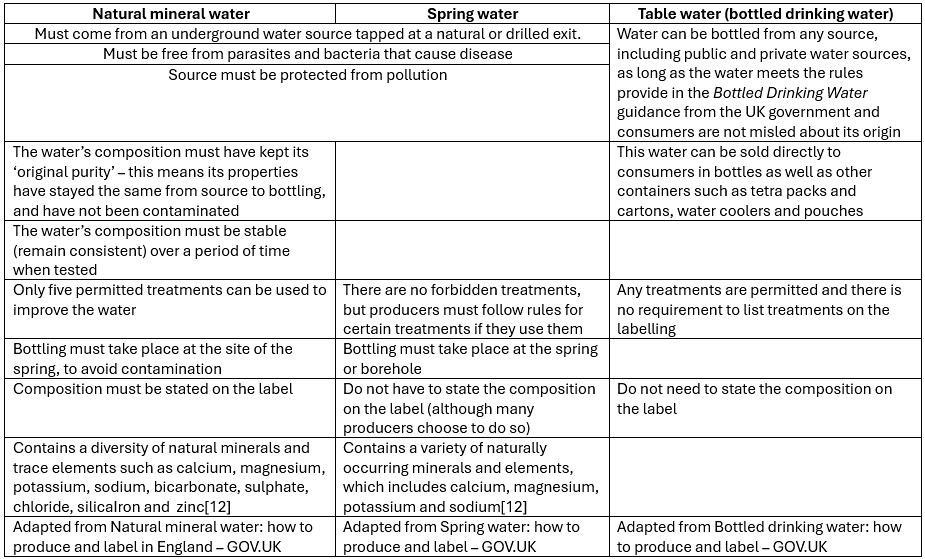
Packaged waters are big business and a huge range of products are available. Natural mineral water and spring water are the two most common options, but what are these exactly? And where does table water come into it?
The table below gives an overview of the differences and similarities.
Regulation and standards
In England, bottled water is regulated via The Natural Mineral Water, Spring Water and Bottled Drinking Water (England) Regulations 2007. These regulations govern the recognition, exploitation, treatment limits, bottling requirements and labelling for all three categories of bottled water. There are similar regulations for Wales, Northern Ireland and Scotland.
Drinking water standards and regulations within the UK are strict and have been in place for many years. Current regulations and guidelines for drinking water quality cover the safety margins for micro-organisms, chemicals such as nitrates and pesticides and metals (lead and copper). The taste and appearance of the water are covered too.[13]
Water is simple, yet essential. From hydration and food to health, agriculture and the environment, it touches every part of our lives. In the UK, most of us enjoy safe, clean water but differences in source, treatment, and minerals mean not all water is the same. This blog only scratches the surface; there’s much more to explore about the role of water, how we use it and the impact it has on our world.

Emma has been a Registered Dietitian for over 18 years and has experience in adult and paediatric dietetics. She has been the Editor of NHD for 10 years, steering the editorial content and supporting the production process. Emma currently works in industry.
Emma Coates, RD
References:
BBC News (2026) Investigation launched into South East Water as thousands still without supplies. Investigation launched into South East Water as thousands in Kent and Sussex still without supplies - follow live - BBC News
Water UK (2026) Drinking water: Safe, clean drinking water is vital to public health. Drinking water | Water UK
Statistica (2025) Bottled water market in the UK - statistics & facts. Bottled water market in the UK - statistics & facts | Statista
Statistica (2025) Total consumption of bottled water in the United Kingdom from 2013 to 2024, Bottled water consumption volume 2024| Statista
Popkin, B.M. et al (2010) Water, Hydration and Health. Water, Hydration and Health - PMC
British Dietetic Association (2023) Fluid (water and drinks) and hydration. Fluid (water and drinks) and hydration - BDA
British Nutrition Foundation (2023) Hydration. Hydration Information - British Nutrition Foundation
NHS (2023) Water, drinks and hydration. Water, drinks and hydration - NHS
Smart Water Magazine (2026) What is Water Made Of? Understanding Water: Composition, Molecular Structure, and Unique Physical Properties | Smart Water Magazine
Langwater Switzerland (2025) Does water have a taste? Does water have a taste? – drinklang
Drinking Water Inspectorate (2026) Water Hardness / Hard Water: What is water hardness? Water Hardness / Hard Water - Drinking Water Inspectorate
Buxton Water (2019) Natural Mineral Water vs Spring Water. Mineral vs Spring Water: What Is the Difference? | Buxton Water
Drinking Water Inspectorate (2026) Drinking Water Standards and Regulations. Drinking Water Standards and Regulations - Drinking Water Inspectorate
Comments